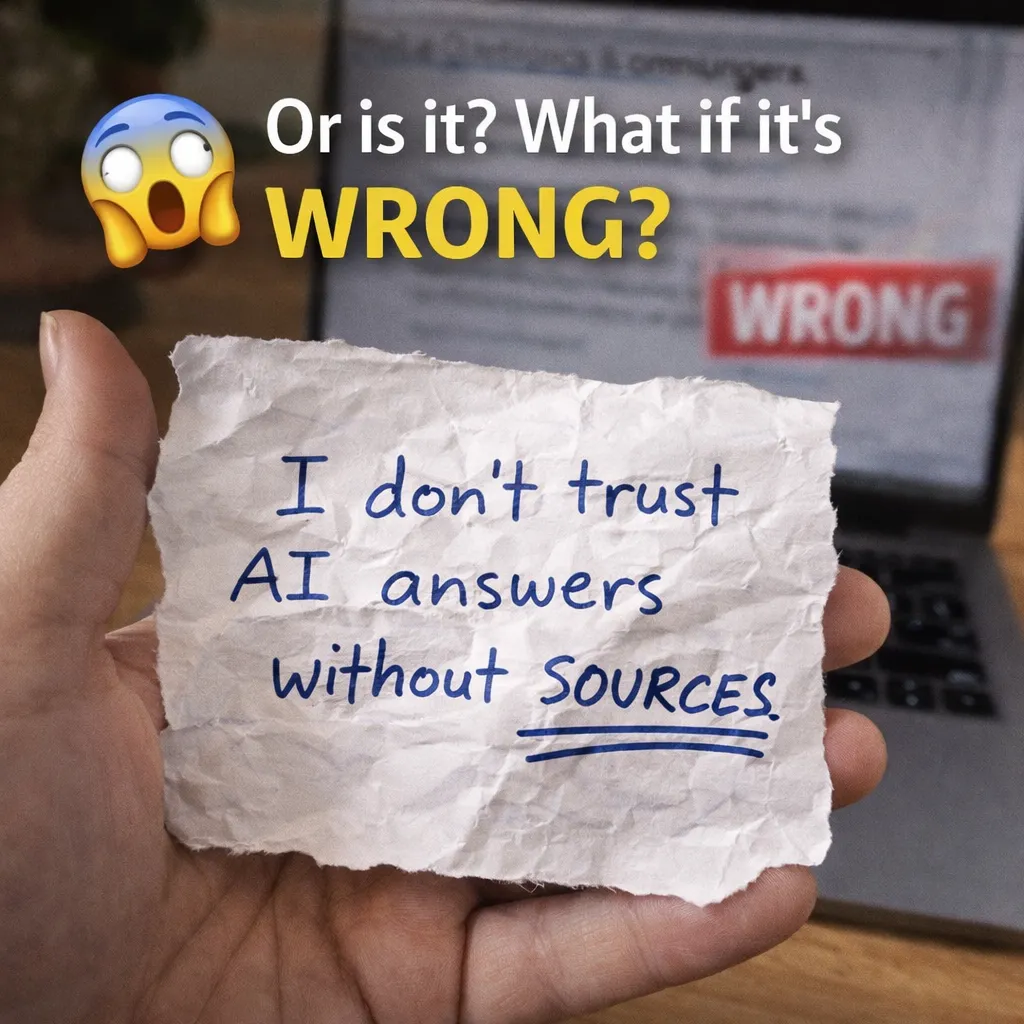
I Don't Trust AI Without Sources
The Hidden Problem With AI Answers: Confidence Without Verification
Introduction
The example that triggered this wasn’t critical. I was asking about equipment selections from the TV show Alone. In the grand scheme of things, that information isn’t very important.
But that’s exactly why it works as an example.
If an AI system can produce confident but incorrect information about something trivial, the same behavior could appear when answering medical, financial, legal, or technical questions.
In those situations, an answer that sounds correct but isn’t verified can be dangerous.
The larger issue is simple: AI systems often prioritize producing a complete answer over producing a verified one.
The Problem
A common pattern occurs when using AI for research:
A user asks for specific information
The user specifies a source
The user instructs the AI not to guess
The AI still produces an answer that appears complete but includes unverified details
This happens because AI systems are optimized to produce smooth, confident responses, even when the data hasn’t been verified.
The result can look credible but contain errors.
For casual conversation this may not matter. For research, it undermines trust.
Why This Matters
Incorrect information is always a problem, but the impact depends on context.
ScenarioImpactTV show equipment listsAnnoying but harmlessMedical informationPotentially dangerousFinancial adviceCould lead to costly mistakesTechnical specificationsCould cause system failures
The issue isn’t that AI makes mistakes. Humans do too.
The issue is when mistakes are presented confidently as facts.
Principles for Reliable AI Research
To make AI dependable for research, responses should follow a few basic rules.
Use primary sources.
When a source is specified, rely on it directly.
Extract facts instead of reconstructing them.
Pull exact information from the source.
Cite sources.
Every factual claim should include a reference.
Say “Not Verified” when necessary.
If something cannot be confirmed, the correct response is Not verified.
A Better Response Structure
A simple structure helps enforce these principles:
Sources – list the sources used.
Extracted Facts – quote the relevant information.
Answer – provide the conclusion based strictly on verified facts.
A Prompt That Helps
When accuracy matters, this prompt helps enforce these rules:
Verified research only. Use primary sources. Cite every claim. Do not guess or reconstruct missing information. If something cannot be confirmed, respond with “NOT VERIFIED.” Quote relevant source text before giving the answer.
Conclusion
This example began with a small question about a television show.
But it points to a larger issue: how AI should behave when users rely on it for factual information.
The solution is straightforward.
Accuracy before completeness.
Verification before explanation.
And when something cannot be confirmed, say so.
That approach builds trust—and makes AI far more useful as a research tool.
